
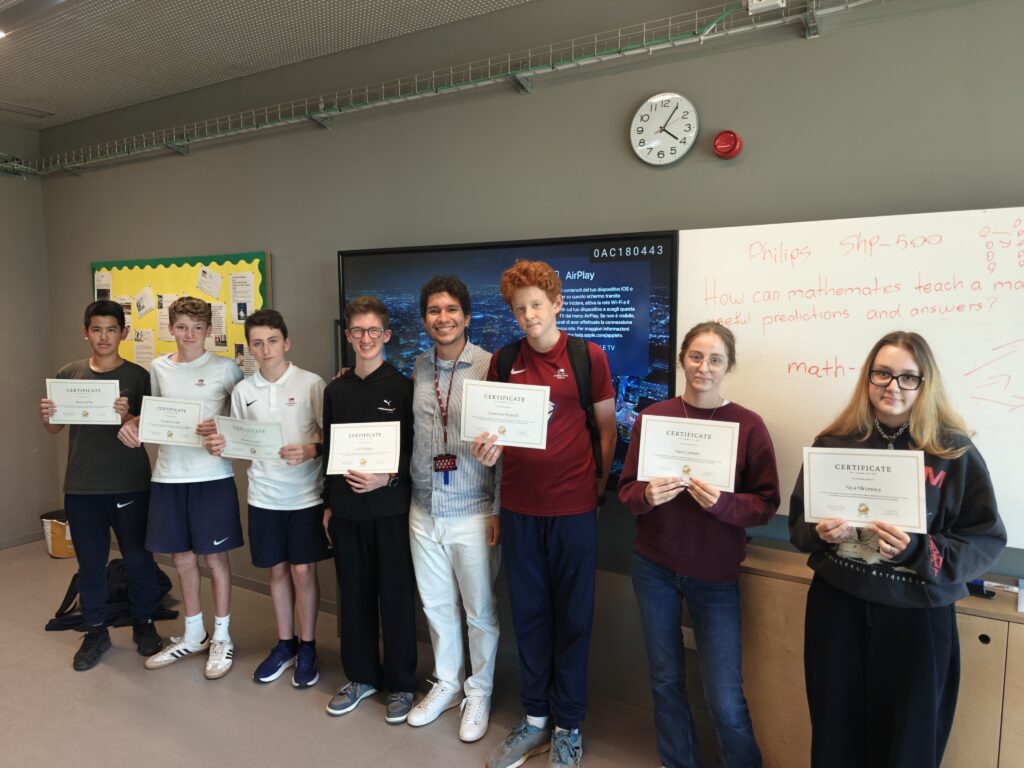
Mathematics lessons. Even on Saturdays. Not out of obligation, but out of passion. The programme is called Euler, after the famous Swiss mathematician, and it encourages students at H-FARM International School to explore the world of numbers and geometry at an ever higher level.
The programme, designed for students in their first year of High School, officially began in September with the first days of school. On Saturday 17 October it held its first out-of-school session, with a full day entirely dedicated to this world.
The students taking part in this special programme, led by the school’s Head of Mathematics Department, John Arevalo, were selected from among those most interested in formulas and equations. They will be guided through this journey of discovery and in-depth study until they complete High School, with clear goals: Higher Level Mathematics, the Mathematics Olympiads and the most selective STEM university pathways in Europe, the United States and Asia.
A year built on time and depth
Euler students attend nine mathematics lessons every week, divided between advanced mathematics (Extended) and in-depth study (Mathematics Enrichment). On top of this come ten Saturdays spread across the school year. In total, more than 400 mathematics lessons in a single year.
The weekly lessons work on two levels, designed as a single experience.
Extended Mathematics (5 lessons a week) explores the curriculum content in depth. In MYP4: algebra and number, including radicals, indices and logarithms; statistics; linear, composite and inverse functions; quadratic equations, modelling and optimisation; trigonometry with 3D applications.
Mathematics Enrichment (4 lessons a week) goes further. The first year, the Toolkit Year, is organised into five modules:
- Logical Reasoning and Mathematical Proof
- Number Theory and Algebraic Structures
- Advanced Geometry and Spatial Visualisation
- Vectors, Matrices and Mathematical Modelling
- Advanced Mathematics for Competitions
Saturdays: mathematics beyond the classroom
The Saturdays serve a different purpose. Each one is a full day, from 8:45 to 16:15, led by a different STEM teacher, with an applied, exploratory and challenge-based approach, far from the traditional lesson.
“We have designed a curriculum that is engaging and inspiring,” explains Antonello Barbaro, Managing Director of the School. “Our school has a different DNA, and so, in addition to classroom lessons during the week to raise their level in mathematics, students have the opportunity on Saturdays to experience how numbers are applied, how they shape our society and our everyday habits, and what impact they have.“
Topics this year include:
- Mathematics and Artificial Intelligence
- The Mathematics of Money
- Olympiad Challenge Lab
- Maths Meets Science
- The Mathematics Behind Computing
- Cryptography and Secret Codes
- Robotics and Mathematical Thinking
- Mathematics of Games
- Mathematics of the Real World
- Logic Workshop
- Maths Innovation Challenge
The first session, led by Mr Christopher Camacho, focused on Computer Science and Artificial Intelligence. “In this first session, we delved into AI, neural networks and Large Language Models (LLMs),” explains Mr Camacho. “We started by laying the foundations and explaining the core concepts of AI: rule-based programming versus pattern-based training, machine learning, deep learning, neural networks, algorithmic prediction and probability, gradient descent, mean squared error and the neuron equation. We carried out several exercises and learning activities to strengthen students’ understanding of how mathematics is applied to predict the outputs of complex machine learning algorithms.”
The day’s project
The day of study and hands-on work culminated in a final project: students built their own maths AI agent using a technique called RAG (Retrieval-Augmented Generation). The project allowed them to put into practice what they had learned about pipelines, machine learning, natural language processing and Python. RAG involves creating a knowledge base from which the model retrieves information exclusively: the model the students built was therefore specialised in mathematics and did not answer questions on any other subject. It was a concrete example of how AI can be applied in an educational context. Through this technique, students were also able to see first-hand how a model is fine-tuned, how its predictions work and how accurately it retrieves information.
Who can join
The programme is open to students entering MYP4 who choose Extended Mathematics and commit to attending the four Enrichment lessons, selecting this subject from among the electives offered by H-FARM’s international pathway. Entry requires a final grade of at least 6 in MYP3 Mathematics, at least 6 in Criterion A (Knowledge and Understanding), and consistently strong results in the Sciences. Students with a final grade of 5 may be admitted through an entrance exam, provided they meet the Criterion A requirement.
Next session: Saturday 14 November, with “The Mathematics of Money”.